Showing posts with label Margaret Lockwood. Show all posts

Sunday, November 16, 2025

Rex Harrison top ten

 1. My Fair Lady (1964)

2. Cleopatra (1963)

3. Anna and the King of Siam (1946)

4. The Ghost and Mrs Muir (1947)

5.  Blithe Spirit (1945)

6. Night Train to Munich (1940)

7. Dr Doolittle (1967)

8. Midnight Lace (1960)

9. Major Barbara (1941)

10. The Rake's Progress (1945) 

Thursday, March 20, 2025

Top unmade Margaret Lockwood films

 1) Rob Roy - announced before WW2, cancelled because of it... a great shame, would've been great, Gainsborough, Ted Black, Will Fyffe, Lockwood..

2) The Blue Lagoon - another Gainsborough project cancelled by WW2 it was good this was made in colour but young Lockwood would've been perfect 

3) Vanity Fair - announced in the late 1940s, presumably cancelled due to the financial crisis. Could have been fun. Maybe. I have limited confidence of Rank.

4) Ann Veronica - adaptation of the novel by HG Wells. Hmm... maybe director dependent. She did do it for TV and no one cared.

5) The Wicked Lady's Daughter - this should have been made. Arliss and company were still around. 

6) Mary Magdalene - Rank wanted to do this. She refused. Hmm.... I like the idea but Rank couldn't have pulled it off. The Americans could have.

Friday, July 16, 2021

British Box Office 1954


Big British hits of the Year:

1) Doctor in the House

2) Trouble in Store

3) The Bells of St Trinians

This year kicked off three franchises that would power through the 50s and 60s: the Doctor series, the St Trinians series, and the Norman Wisdom series (I count that as a franchise).

A golden year for popular British film.

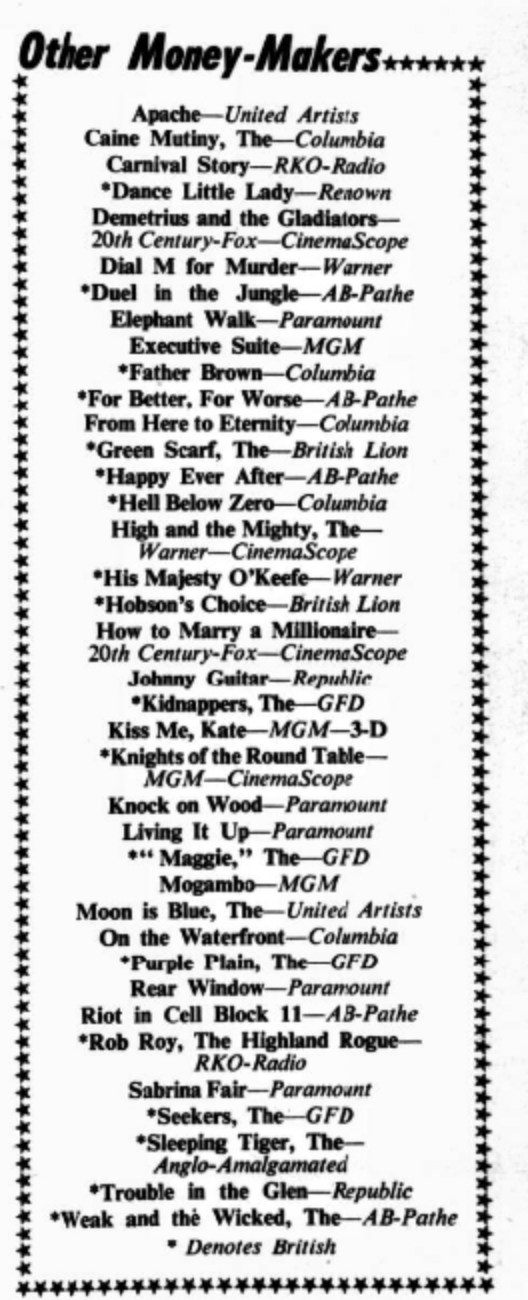
The Other Money Makers list is interesting. The British films on it were:

* Dance Little Lady (a forgotten Val Guest film with Mandy Miller and Terence Morgan - I had never heard of it)

* Duel in the Jungle (basically American adventure tale)

* Father Brown (Alec Guiness as the crime solving man of God... why no franchise?)

*For Better, for Worse (hideous newly wed Dirk Bogarde comedy)

* The Green Scarf (random mystery)

* Happy Ever After (musical with David Niven)

*Hell Below Zero (basically American adventure tale with Alan Ladd)

*His Majesty O'Keefe (lots of Aussies in that - shot on Fiji)

*Hobson's Choice (David Lean, Laughton, Mills)

*The Kidnappers

*Knights of the Round Table

*The Maggie (late Ealing comedy I had heard was a flop)

*The Purple Plain

*Rob Roy

*The Seekers ( Glynis Johns in New Zealand)

*The Sleeping Tiger

*Trouble in the Glen (so this did okay!)

* The Weak and the Wicked

It's an interesting array of movies. Lots of adventure tales shot here. Comedies very big. Some war movies. Thrillers.

Sunday, October 25, 2020

Movie review - "Trouble in the Glen" (1954) **

 One of the films that helped kill Margaret Lockwood's career.  Is it so hard to rip off The Quiet Man? Republic and Herbert Wilcox got the same writer and Victor McLaglen. And if they couldn't get John Wayne they tried with Forrest Tucker.  

Tucker is no John Wayne - he can act and lumber but doesn't have the same charisma. He isn't helped by the dumb story. He's an outsider (an American who served in the army during the war) and so too are Margaret Lockwood and father Orson Welles. Why have three outsiders? 

Actually you don't need Tucker in the film. The movie should have been about Lockwood and Welles moving to Scotland, being fishes out of water... and she has a romance with Scotsman John McCallum. Tucker is an adjunct and so is that polio riddled girl they shove in and spend far too much screen time on

Also for a Scottish Quiet Man the film is incredibly non Scottish. The Quiet Man had Maureen O'Hara, Barry Fitzgerald and all these Irish actors plus was filmed in Ireland. This feels totally un Scottish. It seems to have been mostly shot on the backlot and has non Scottish actors like John McCallum and Victor McLaglen. Was Finlay Currie not working?

The slackness of this just got to me.


Saturday, October 24, 2020

Book review - "My Lucky Star" by Margret Lockwood (1955)

 Charming memoir from Lockwood, quite early in her career, really - twenty years in. But, as it turned out, it came as she stopped being a film star.

It was an eventful life. She was born into Karachi, moved to England, started acting young, made a fair fist of it early on, helped by her beauty, talent, and the support of Gainsborough. 

I would have liked more about the movies and co stars - there's no a lot here. There is a lot about her husband, her mother, her lover "Bill", and most of all her daughter Toots, the great love of her life. This is very sweet.

Sunday, October 11, 2020

Book review - "Patricia Roc" by Michael Hodgson

 Entertaining, affectionate biography of the star, an endearing heroine of the 1940s. Roc was lucky in many ways - pretty girl, well off background - who wanted to be in pictures. She had a pleasant on screen presence that ensured work in "girl" parts. She was fortunate to come up in the 40s when for a brief moment British cinema actually cared about promoting female stars. Roc had a "girl next door" quality that was spot on and became a name in Gainsborough movies such as Millions Like Us.

What makes the book interesting is the oddness of Roc's career - genuinely popular for a brief time. she kept in public attention due to support of people like J Arthur Rank, but when the tide went out it went out quickly. It also helps that Roc had a colourful personal life - she loved sex, always had affairs (Anthony Steel fathered her child), was nicknamed "bed rock". Married for money eventually, seemed to regret it... she was arrested for shoplifting. I think she missed acting but maybe was more into the lifestyle than the craft. I could be wrong.

Affectionate, easy to read book.

Tuesday, January 21, 2020

Movie review - "Laughing Anne" (1953) ** (warning: spoilers)

Margaret Lockwood signed with Herbert Wilcox in a multi picture deal attempting to revive her career. The films weren't popular, particularly this one which is a South Seas tale of all things, though with minimal location work although it is in colour.

It was a co production with Republic so there are two American "stars" - Forrest Tucker and Wendell Corey. Corey is a captain who hooks up with lounge singer Margaret Lockwood - in a French accent channelling Marlene Dietrich or Yvonne de Carlo. She flashes back to her romance with Forest Tucker, who got his hands chopped off because he wouldn't throw a fight.

The film really needed to star someone like de Carlo or Maureen O'Hara and Jeff Chandler. The basic story isn't bad - from a story by Joseph Conrad - but its sluggish. Corey and Tucker are second tier, and Lockwood looks uncomfortable. I mean she throws herself into it with the accent and singing but it's unconvincing.

Wilcox's direction is lethargic and the story is depressing - Tucker gets his hands cut off and is a loser, Lockwood winds up dead, Corey's wife leaves him.

Tuesday, January 15, 2019

Margaret Lockwood Top Ten

1)The Wicked Lady (1946) - may as well get this over and done with - great fun
2) The Lady Vanishes (1938) - classic film, one of Hitchcock's best, so different from Wicked Lady - she's good in Night Train to Munich as well but really playing the same sort of role (she has more to do in the Hitchcock)

3) A Girl Must Live (1939) - Lockwood is bright and vivacious for Carol Reed
4) Bank Holiday (1938) - another good performance by Lockwood for Reed
5) I'll Be Your Sweetheart (1945) - fun musical with Lockwood in an Alice Faye type role
6) Cast a Giant Shadow (1955) - Lockwood is almost unrecogniseable in this very good film
7) The Man in Grey (1943) - the film that changed her image and she's very good
8) Love Story (1944) - Lockwood is a goody here and very effective
9) The Stars Look Down (1939) - she tries some different stuff, in a decent film
10) Madness of the Heart (1949)

I realised I did an earlier top ten for here. Basically the same only Sweetheart got in.

Thursday, November 15, 2018

Movie review - "The Wicked Lady" (1946) ****

(originally published for the Blacklist)
Here’s a pitch for an erotic thriller…

Meet Barbara. Twenties. Sexually voracious. Stunning. Emotionally messed up by her mother’s death. Visits her boring best friend from high school who’s in love with an older rich guy. Barbara seduces the old guy, marries him, moves into a mansion.

Barbara gets bored. She gets the hots for a hunky young dude she meets at her own wedding and tries to seduce him. She stops sleeping with her old husband and starts robbing people for kicks and a bit of spare cash. She meets another thief, and they start a torrid affair. A servant of the old guy busts her, but she kills him with poison. She catches her thief lover in bed with another woman, so shoots him dead. She falls in love with the hunky younger dude, and he loves her — but he shoots her while she’s committing a robbery, not realizing it’s the woman he loves. She dies from her wounds. The old guy winds up back with the boring best friend.

Sex, murder, betrayal, robbery, couple swapping, irony…. You can see it, can’t you? In 1993 you’d have Shannon Tweed or Tanya Roberts as Barbara, and Andrew Stevens as one of the male leads.

But it wasn’t made in the 1990s — it was actually shot in 1945 and it was called THE WICKED LADY.

And it was one of the most popular British movies of all time.

THE WICKED LADY was one of a series of films known today as “Gainsborough melodramas.” They made in the 1940s by Gainsborough Pictures, usually set in the past, and turned actors like Margaret Lockwood, James Mason, Stewart Granger, and Phyllis Calvert into stars. The plots were full of sex, greed, longing, murder and death. In THE MAN IN GREY (1943) Lockwood sleeps with Mason, the abusive husband of her best friend Calvert, who is actually in love with Granger; Lockwood arranges for Calvert to die, but is killed herself by Mason. In MADONNA OF THE SEVEN MOONS (1944) Calvert is married with a daughter when she discovers she has a split personality that makes her run off to Florence and become the mistress to thief Stewart Granger. In CARAVAN (1946) Stewart Granger loves Anne Crawford but loses his memory and marries gypsy girl Jean Kent.

The films were critically despised and enormously popular (in Britain at any rate — American audiences never much went for them.) Being set in the past allowed not just cool costumes and sets, but enabled a lot of (relatively) daring sexual and political content to get past the censor. This had resonance during the social upheaval of World War II, particularly for female audiences experiencing unprecedented financial and sexual independence at the time.

The stories normally focused around a “good” woman and a “bad” woman, who would drive the action, and gave audiences a choice of who to identify with/fantasize over. The bad woman usually slept around a lot, murdered people and was killed at the end, but she was also (in the better of these films, at least) depicted with some empathy — it was clear she was “that way” for a reason, whether a restrictive society, a cruel husband, love of a dud guy, etc A sympathetic character could still genuinely love the bad girl, as in THE WICKED LADY. And the “good” girl was always shown to have strong sexual drives — she was just better able to control them — and her passivity was normally shown to have bad consequences, eg. sitting back and watching another woman steal your husband. They did a similar good-bad split with their male leads — the good man was dashing but decent and poor, the bad man was cruel and violent but also rich and sexy.

By the late 40s the genre died out as the films became less popular. Its death was helped along by executives and stars embarrassed by the films’ complete lack of critical acclaim, but it has to be admitted that later Gainsborough melodramas movies don’t work as well as the first ones. They were either given the serious, “respectful” treatment and became a lot less fun (e.g. SARABAND FOR DEAD LOVERS, 1948), or began to focus too much on the male characters (e.g. HUNGRY HILL, 1947, BAD LORD BYRON, 1949) or they were miscast (anything with Dennis Price in a lead), or they were simply ineptly done… For instance JASSY (1947) and THE ROOT OF EVIL (1947), instead of having two female leads, one good and one bad, both feature the one female lead who is a mixture of good and bad, which may be more true to life, but tends to be dramatically unsatisfying and rob the films of narrative drive and conflict.

The films were harder to make well than people realized at the time, or indeed later — for instance, take a look at the Faye Dunaway-Michael Winner remake of THE WICKED LADY (1983.) It adds nudity and violence, including a duel with horsewhips between Dunaway and a topless Mirina Sirtis, but lacks the same energy and focus.

The 1945 WICKED LADY was not robbed when overlooked at Oscar time. It is often silly — practically every scene has a moment which feels like “this is the subtext” is being subtitled on screen. The actors ham it up — Margaret Lockwood’s nostrils literally flare in some scenes. It is not politically correct. There is an unpleasant rape scene.

But it has a plot full of action and incident; it has clearly defined characters who behave logically and contrast in clear ways; it is centered around a fascinating female protagonist who is not likeable but always compelling and whose desires (for sex, love, money, safety) drive the bulk of the story; there are strong male characters (well, two of them). And, for 1945 British cinema, it is extremely erotic — people have sex in fields, cheat on spouses, fall in lust at first sight — and is thrilling. It has integrity. And what your erotic thriller needs as much as eroticism and thrills, is integrity.

Monday, December 04, 2017

Script review - "The Lady Vanishes" by Launder and Gilliat

This would have to be one of my favourite scripts of all time. It's so lovely and clever and fresh and funny. And the structure is to die for. Things are brought in and paid off beautifully, the characters are clearly delineated and warmly sketched. Yes I like it in part it's about cricket but also because of its cleverness and wit and excitement.

Irish is a cheerful young girl but that's all she has to be; Gilbert is given some real background (folk dancing, impoverished father) - though I do wish Iris had been given more of the nun's heroic stuff at the end (there you go, flaws). Miss Froy is the greatest secret agent of all time; the villains (Dr Hartz, the Baronness) may be evil foreigners but they are smart and gentlemanly (at the end Hartz says "good luck to them"); the subplot about the cheating couple is very adult and believable; the nun in high heels (who does a lot of heroic stuff at the end) is brilliant, going back to her country in the hour of need; Charters and Caldicott are splendid.

Break it down into sequences
A - meet all the characters in a comic, fun way - bewildered Britishers and flustered foreigners. End with the singer being murdered
B - get on the train, someone tries to kiss Miss Froy and Iris gets conked on the head, set up the passengers in the compartment and the tea and the name on the window, then go to sleep - wake up and Miss Froy is gone
C - Iris looks for Miss Froy, everyone denies her including the British (to avoid getting in trouble), Gilbert and Dr Hartz try to help, Irish sees Miss Froy's name, a woman gets on the train, Hartz persuades Iris that she imagined it but then Gilbert sees the tea and believes her - reveal that Hartz is in on it with the nun and the woman
D - Gilbert and Iris keep looking and get in a fight with the man in the compartment. Hartz reveals his plan to drug Gilbert and Iris to the nun and he drugs them...
E - But they wake up. Turns out the nun helped them. They rescue Miss Froy and try to put someone else in her place. They almost get away with it but Hartz figures out what's going on. And orders the train to be diverted.
F - The train is diverted but it's the dining room and the British are left. They manage to fight them off, especially Gilbert and the nun. Miss Froy reveals who she is and makes a run for it.
G -Gilbert and Irish get together and discover Miss Froy's still alive.

Wonderful stuff.

Wednesday, November 01, 2017

Could Margaret Lockwood's career have been saved?

I've been thinking about Margaret Lockwood lately, as you do (okay no one does except me) - in particular, about what went wrong with her career after the triumph of The Wicked Lady. The most popular star in Britain at what was arugably the high point of the British film industry... within ten years her name was thought to repel audiences from Cast a Dark Shadow.

During World War Two Lockwood's resume was full of hits, notably the Gainsborough melodramas - The Man from Grey, Wicket Lady, Love Story. She was also in some well received other kinds of films such as Dear Octopus and I'll Be Your Sweetheart.

Let's look what followed:
*Bedelia (1946) - which could and should have been right her up her alley (she played a murderess) but was hurt by some odd scripting decisions and inadequate casting
*Hungry Hill (1947) - should have been a blockbuster but the film lacked focus - it needed to be about Lockwood's character through and through but instead she pops in and out of it
*Jassy (1947) - did okay at the box office - a half success - but could've done better. Again, the movie lacked focus. Was Lockwood good or evil or what? It felt like a movie that didn't know what it really was.
*The White Unicorn (1947) - I haven't seen this film yet. It's about delinquent girls.It was a melodrama. Didn't sound very exciting.
*Look Before You Love (1948) - I haven't seen this either but it sounds terrible.
*Cardboard Cavalier (1949) - Lockwood tries comedy but instead of using a well worn source material she decides to play foil to Sid Field. It's not a very good movie.
* Madness of the Heart (1949) - not a bad melodrama, though it has a poor rap. Lacks big name co-stars.
*Highly Dangerous (1950) - an attempt to make a Lady Vanishes style film but it never seems sure of her tone.
She then made three poorly received films for Herbert Wilcox, and basically ceased to be a star.

So anyway what happened to Lockwood's career? What could she have done differently?

I'll try not to be too harsh in hindsight here but it seems her main errors were

*Not featuring against bigger stars. Most of her late 40s movies lacked names- no Phyllis Calvert, no Stewart Granger or James Mason. You had people like Denis Price, Dermot Walsh, Griffin Jones, Dane Clark.... very much the second eleven. Nothing wrong with making a trashy movie but the trashier films generally need stars.

*She should have been the focus of more of her films. Hungry Hill and Jassy in particular pulled against the fact they needed to be women's pictures, about women.

*She should've tried Hollywood. I understand her reluctance, but the material was simply better. Interestingly all the big British stars of the late 1940s - Mason, Granger, Anna Neagle, Michael Wilding - suffered when the 1950s came in, in Britain. The only ones to survive were those who went to Hollywood and stayed. (Phyllis Calvert and Patricia Roc gave it a go but didn't stay).

Margaret Lockwood... a big star who should've been a LOT bigger.

Tuesday, September 26, 2017

Dirk Bogarde Top Ten

1) Doctor at Sea  (1955) - high-spirited fun comedy, which I prefer to the first one because it has some sea views and Brigitte Bardot
2) Victim (1961) - for an actor in the closet Bogarde played an amazing number of gay characters for the time - this one notably, a hard hitting genuinely entertaining thriller that became unfashionable for a time but retains its power
3) The Servant (1963) - Bogarde played a few creepy corrupters in his career but this was perhaps his greatest performance in that genre
4) A Tale of Two Cities (1958) - perhaps Ralph Thomas' best film, a very fine adaptation of the novel with Bogarde excellently cast.
5) Hunted (1952) - part of the young-kid-idolising-a-crook genre, with Bogarde excellent as a spiv
6) The Blue Lamp (1949) - Bogarde makes a superb villain and I wish he'd played more
7) The Wind Cannot Read (1958) - presumably David Lean would've made a better film but this is a pretty good melodrama
8) The Doctor's Dilemma (1959) - Bogarde and Shaw go together well in a literate, entertaining film
9) Death in Venice (1971) - it is about, well, a pedophile and has some shocking make up but is very well done
10) Cast a Giant Shadow (1955) - Bogarde again makes a marvellous villain well teamed with Margaret Lockwood in character actor mode

Sunday, September 04, 2016

My Stewart Granger Top Ten

1) Scaramouche (1952) - Granger's best film and best performance - wonderful fun
2) Moonfleet (1955) - flawed but entertaining smuggler movie
3) All the Brothers Were Valiant (1954) - fun adventure tale with Granger an ideal villain
4) Caravan (1946) - outrageous Gainsborough high camp fun
5) Captain Boycott (1947) - intelligent well made period movie
6) Fanny By Gaslight (1944) - strong melodrama
7) The Man in Grey (1943) - the film that made Granger a star and it still holds up
8) The Prisoner of Zenda (1952) - it may have remade the Selznick version exactly but this is still good
9) Bhowani Junction (1956) - underrated post colonial melodrama
10) Waterloo Road (1945) - smug in many ways but Granger gives one of his best performances as a spiv

 Richard Burton wrote in his diary that you couldn't have a Stewart Granger Film Festival. Is this true? Well, it would be a little low rent.

But thinking classy movies

- Some Launder and Gilliats: Waterloo Road, Captain Boycott

- Caesar and Cleopatra

- Some Gainsboroughs: Man in Grey, Fanny by Gaslight, Love Story, Madonna of the Seven Moons, Magic Bow

- MGM auteur pieces: Moonfleet (Fritz Lang), Bhowani Junction (George Cukor)

- Scaramouche!

So you could.

Saturday, May 14, 2016

Movie review - "Man of the Moment" (1935) *

Terrible British comedy with amateurish acting and handling. There are two interesting things about it - the cast and an unexpected dark undertone. Douglas Fairbanks Jnr pulls Laura La Plante out of the river after she's tried to kill herself following an unhappy love affair (this is treated comically); he looks after her which upsets his fiancee (Margaret Lockwood, very young). Lockwood dumps him so he heads to Monte Carlo to gamble - leading to some location filming.

I didn't know much about La Plante but she was fairly terrible. I like Fairbanks Jnr but the material defeated him. Lockwood was very green. This was heavy going although it did improve as it went on.

Saturday, May 07, 2016

Movie review - "Doctor Syn" (1937) **

Doctor Syn was a popular figure in British literature - a parson by day, smuggler by night. He's played here by George Arliss, an ancient looking dude who was a film star in the 1930s. He's okay as Syn, though he lacks dash.

Director Roy William Neill made some good films in his time but this is pretty creaky. In part because I watched a crap print where you couldn't tell what was going on in the night scenes. But also dramatically - you're all too aware so much exciting stuff happens off screen (the death of Clegg/Syd's wife, his revenge against the pirate). I think the person who killed his wife needed to be alive.

The plot involves the authorities figuring out what Clegg/Syd is up to but it's never that exciting. There is some sweet stuff involving a young Margaret Lockwood who is Arliss' secret daughter; their scenes work - a lot more than Lockwood's love for drippy lunk John Loder.  There's some lively trap doors and creepy covers and I enjoyed the fat kid.

Movie review - "A Girl Must Live" (1939) ***

Really fun, bright British comedy about three showgirls on the make, full of energy and bright Frank Launder script. Launder wrote this without Gilliat; it was interesting to contrast this with Girl in the News, which was also directed by Carol Reed starring Margaret Lockwood but was written by Gilliat without Launder. This was a better movie, a lot more fun - and made me wonder if Launder was a better writer than Gilliat. Of course it simply maybe personal taste, the source novel, anything... But it seems Launder was better at comedy. You can definitely feel The Lady Vanishes here more than in Girl in the News.

Anyway Margaret Lockwood is bright and vivacious in Lady Vanishes mode as a bright young thing who flees finishing school and winds up on stage. Her cronies include Renee Houston and an achingly young Lili Palmer. Everyone is good as is the support cast including Naunton Wayne.

The film feels influenced by those Warner Bros musicals of the early 1930s with girl's minds on money and doddering old men interested in sex. This makes it refreshingly adult. There are a few musical numbers but it's not really a musical.

The girls run around in their underwear a lot, Houston and Palmer have a cat fight, Wayne is a drunken burglar, Hugh Sinclair is the noble who Lockwood falls in love with. This romance is a little abrupt - Sinclair comes into the piece too late and is too sketchy a figure. It was the biggest flaw of the film for me. But Reed and the writers have such affection for their characters this is a hard movie to dislike and I found it a delightful surprise.

Monday, May 02, 2016

Movie review - "The Girl in the News" (1940) **

Unpretentious little British melodrama which reunites Carol Reed and Margaret Lockwood in what was their fifth teaming, I believe. It has an intriguing idea: Lockwood is a nurse who is put on trial for killing a patient; she just gets off in part due to the skill of her lawyer Barry Barnes, but when a second patient is killed things look grim.

Oddly, Lockwood played a version of this in the later movie Bedelia where she was guilty of knocking off various husbands. Here she's innocent. And this could have made an ideal Hitchcock movie, with it's thriller aspects, lawyer falling in love with accused, butler having affair with married man. But there is not much pace - most of the action is set around courtrooms.

Lockwood is warm and sympathetic - she made such a good bitch later in her career that it's good to be reminded what a winning heroine she could be. Barnes is a wet drip (something many British leading men of this period were). There is a strong support cast, including Emlyn Williams (suspicious butler), Roger Livesey (the detective - shame he didn't play the male lead), Margaretta Scott (non grieving widow). Script is by Sidney Gilliat so it's logical and well done. It just lacks spark ad humour.

Sunday, May 01, 2016

Movie review - "Bank Holiday" (1938) ***

An early landmark in the career of Carol Reed and Margaret Lockwood, who were solid names of British cinema in the 30s and became legends in the 40s. It's a simple enough tale of various people going away for a weekend - rather like the later Holiday Camp, which surely ripped off this film.

The stories aren't that much - two girls go looking for boys, a working class family hang out and are working class, and the most screen time is given to a slightly creepy tale about a nurse who meets a guy waiting for his wife to give birth, the wife dies, the nurse goes off for a weekend away with her boyfriend (they're not married) but she can't stop thinking about the guy. The plots in Holiday Camp were much better - there was more of them and they were better structured.

It is redeemed by the acting and the handling, which is very confident. Small roles are played by people like Felix Alymer and Wilfrid Lawson; Walter Patch and Kathleen Harrison are strong as the working class couple. Margaret Lockwood is lovely as the nurse, reluctant to hop in the sack with boyfriend Hugh Williams and obviously keen on newly widowed John Lodge. Rene Ray is quite good as the girl prepared to accept Williams the moment Lockwood's dumped him. (The women in this jump on a guy the moment he's single).

The tone of the stories are pleasingly adult - there's no doubt Williams wants to have sex with Williams, the world weary acceptance about the world from the hotel staff and police, Lodge contemplates suicide. There are neat touches such as all the people sleeping on the beach, the dancing, the scenes at the train station. I preferred Holiday Camp but this has a lot to admire.

Movie review - "Hungry Hill" (1947) **

Daphne du Maurier's novel was a best seller, a saga of Irish families in the 1840s and onwards. I'm surprised MGM didn't buy the film rights for Greer Garson, but Britain's Two Cities nabbed it instead. It starts out promisingly, with location filming in Ireland, and instant conflict - Cecil Parker wants to mine on a land, another family don't like that, his two sons (Michael Denison and Dennis Price) are different and both love trashy Margaret Lockwood.

But then Denison dies and we're left with the less charismatic Dennis Price and the movie goes downhill. It focuses on Price whose character is never quite clear - he's jealous of his dead brother, doesn't want to be in mining, but nothing seems to drive him - then Price's character dies and the focus switches to his son, Dermot Walsh. He's a negative character too, spending a lot of time drinking and whingeing and being a wastrel and mean to his mum.

It's not easy adapting epic novels for the movies because they risk going all over the place, which is what happens here - Gone with the Wind worked because it focused on Scarlett and Rhett. This has no center. It begins with Parker, then we shift to Price, then we shift to Walsh.

There's a possible center, Margaret Lockwood's character, the woman in love with one brother who dies, then marries the other one despite not really loving him, then who comes to love him as she dies, then spoils their son and is rejected by him, then sees him die and wonders about revenge. It's a mystery why, at a time when Lockwood was the biggest female star in British movies, they didn't make it into a proper vehicle for her and made her drive the action. But they don't. I can't even get a fix on her character - she starts of as a flirty vixen type then becomes a drab housewife, then a suffering mother.

There are other problems here too: for instance, a key factor in these character's lives is a feud between two families. But we only focus on one family really, the rich one and never see much of the others, the Donovans. They throw in Donovans periodically - one to lead a mine strike, a sister to sleep with Walsh, the brother of the sister - but never spend any time on one. Why not some matriarch to clash with Lockwood?

Let's take a walk on the sunny side. It's impressive looking, with good sets and some location work. The cast is strong; the leads could admittedly have been more charismatic (Walsh, Price never could match Stewart Granger and James Mason) but everyone can act. It begins in a lively way, Lockwood's character is initially compelling, and there are some memorable sequences, such as a mine flood, a mine riot and a dancing sequence where the music speeds up and everyone spills outside (which actually has nothing to do with the main story).

But on the whole the filmmakers show far less udnderstanding of what makes an entertaining, successful melodrama than the gang over at Gainsborough.

Saturday, April 30, 2016

Movie review - "Cardboard Cavalier" (1949) **

Sid Field was a popular British stage comedian who never made it as a movie star despite a few expensive attempts, this being one. As a vehicle for the comic it's poorly constructed, with a lack of comic set pieces, or strong support cast, or laughs. It takes too long to introduce Field and is far too serious for much of the running time.

The basic idea isn't bad isn't bad - Field is a barrow boy used as a spy for Charles II during the time of Oliver Cromwell. Bob Hope made a bunch of these historical comedies, but they were done by people who knew what they were doing - plenty of colour, gags and songs. This one feels amateurish.

The main problem is it isn't funny. I know that's a matter of personal taste, but evidently the British public of 1949 agreed with me for they did not turn up in expected numbers. It badly lacks comic sequences. And when they attempt it - eg banter between Field and a royalist lord, Jerry Desmonde - it doesn't really work.

Part of this is due to the weakness of the support cast. Lockwood tries, in a blonde wig, but she's not a natural comedienne; for all her efforts she looks like someone out of her league - and the film is geared too much towards her. Jerry Desmonde, as a royalist officer, was Field's regular on stage collaborator but he's not much good in the film.

It does pick up towards the end when the dramatic lines become simpler - Field and his gang try to break into a castle, resulting in them dressing up (Field in drag). There's pace and movement but it never hits home.