Showing posts with label Joseph Losey. Show all posts

Saturday, July 27, 2024

Proposed Australian films of the 1930s to the 1960s

*Big Timber - from novel by William Hatfield  - announced 1935 - instead Cinesound filmed Tall Timber

*Call me when the Cross Turns Over - from novel by D'arcy Niland to be filmed in 60s with Diane Cilento and Sean Connery but not filmed

*Careful He Might Here You - optioned in 1963 by Josh Logan who wanted to make it with Elizabeth Taylor (who would've been great)

*Collits Inn - Frank Thring was going to film this musical but died

*Come Away Pearler - Colin Simpson novel optioned in 1954 by Joe Kaufman see here

*Come In Spinner - novel optioned in 1954 by Joe Kaufman

*Conn of the South Seas - Cinesound said in 1932 might remake The Adorable Outcast see here

*Desert Legion - Raymond Longford WW1 story

*The Delinquents - from novel adapted by Alan Seymour for producer Joseph Janni  and director Jack Lee - announced 1963

*Dig - story of Burke and Wills from Ralph Peterson script for Anthony Quayle  - announced 1957

*Don Bradman biopic - proposed by Ron Randell in 1952 see here

*Eureka Stockade - Ken Hall version 

*The Fatal Wedding - Cinesound said might remake this in 1933 see here - this may have just been a random announcement though Cinesound did make Silence of Dean Maitland

*Fisher's Ghost - sound remake by Raymond Longford of his 1925 hit - Tony Buckley says towards the end of

*For the Term of His Natural Life - Cinesound said in 1932 might remake it see here

*The Fortunes of Richard Mahoney - adaptaion of novel to be done by MGM in the late 40s with Greer Garson and Gregory Peck

*Ginger Murdoch - optioned by Frank Thring

*Gold Dust and Ashes - from novel by Ion Idriess announced 1935 by Cinesound see here

*The Green Opal - Chips Rafferty film about immigration

*The Haunted House - announced by Cinesound in 1938 see here 

*James Don't Be a Fool - EV Timms novel

*The Kelly Gang - Cinesound said in 1933 might remake it see here

*Les Darcy film - announced by Chauvel in 1947 to star Tommy Burns see here

*Life of Nellie Melba - proposed 1940 Cinesound film with Marjorie Lawrence

*The Long Shadow - 1947 Jon Cleary novel optioned in late 60s but not made 

*Mr Burke and Mr Wills - Burke and Wills story written by Terence Rattigan

*My Love Must Wait - novel about Matthew Flinders optioned by Charles Chauvel

*Naked Under Capricorn - published 1958 owned by Chips Rafferty

*Ned Kelly - directed by Karel Reisz starring Albert Finney announced 1963

*The One Day of the Year - Alan Seymour's play, filmed a few times for TV, optioned in 1970

*Overland Telegraph - 1939 announcement Frank Clune sold to Cinesound, he'd write it up in 1955

* Pearl of Great Price - late 30s Cinesound announced 1936 see here

*Pepper Trees  - Ealing film late 40s with Chips Rafferty and Tommy Trinder - scheduled for 1948 see here

*The Pioneers - Cinesound said in 1932 might remake it see here

*Redheap - novel by Norman Lindsay to be filmed by Thring 

*Return Journey - film about Burke and Wills which collapsed in the 1960s but resulted in a short

* Robbery Under Arms - Ken G Hall version, mentioned from the 1930s until the 1940s but killed off by Rank's interest and dud 1957 film

*Rudd's New Selection - announced in 1933 see here - became Grandad Rudd

*Sara Dane - from the novel, starring Sylvia Syms, proposed late 1950s

*Saturday to Monday - original of The Siege of Pinchgut - announced in 1950

*Sheepmates - started filming but abandoned

*Storm Hill - Eric Porter film announced in 1946

*Wake in Fright - directed by Joe Losey starring Dirk Bogarde - announced 1963 - there was also a proposed Morris West version

*Wards of the Outer March - novel adapted by Charles Chauvel  - announced in 1944

*When Cobb and Co Was King - novel optioned by Charles Chauvel

*Yellow Sands - Cinesound in late 30s - announced 1936 see here

Sunday, May 05, 2024

Book review - "Dancing on the Edge" by Russ Tamblyn

 I spoke with Tamblyn in 2004 and he said he wanted to write a book so it took him a bit of time but I think Tamblyn likes to go his own way in life. A genuine name in Hollywood in the 1950s - not a big star, but a regular lead player in studio films with a long term contract to MGM - he dropped out very quickly, via choice really (he moved to Topenga Canyon to pursue art). He never got his groove back, could never quite re-consolidate despite a stint in Twin Peaks but hung in there. Found love third time round.

I liked the book. Listened to audio version. Tamblyn did it. He sounds amiable, a bit spacey. The third section is mostly about his daughter and Neil Young - like many in Hollywood people try to stay relevant where they can.

Interesting vignettes. Jeff Richards was a boozehead and smashed up Tamblyn's place, Dean Stockwell was a good friend but eventually alcoholism destroyed him while Dennis Hopper of all people got over it, Tamblyn was a polyamorist in like 1960 at Malibu, his second wife was a boozer (she's a tragic figure), his first wife an interesting character (Anna Lee's daughter), Glenn Ford tried to get Tamblyn's dance removed from Fastest Gun in the West, Tamblyn and Yvette Mimieux went for a skinny dip and had sex one night making Brothers Grimm, Tamblyn had a fling with Regina Carroll making Satan's Sadists.

If you like that period and these movies this book is hard to resist, even if it does need an edit.

Saturday, January 27, 2024

Movie review - "The Lawless" (1950) ***

 Pine-Thomas' only real attempt to make a "critics' picture" is pretty good, helped by some quality talent - Daniel Mainwaring wrote the script, based on his novel, and Joseph Losey directed. It uses some Paramount stars, Macdonald Carey and Gail Russell, who are effective. Russell's sad eyes suit the role.

It's about prejudice against Mexicans in a California border town. The emphasis is on white Carey, a journalist, who doesn't really have skin in the game... but I recognise that sort of compromise is needed to make the movie work.

There's a satisfying riot and a good deal of intelligence. It's a shame they had to rely on a "fake rape" narrative and a kindly rich white man to come along at the end and fix things. Tab Hunter has a small part - it was his debut.

Thursday, March 23, 2023

Movie review - "The Gypsy and the Gentleman" (1958) **

 The frustrating thing about Rank was that their ideas were solid but they could never get the execution right. It was a good idea to bring back the Gainsborough melodrama style, and some solid talent spotting that saw them assign the film to Joseph Losey, and allow him to cast Melinda Mercouri as a gypsy, and Keith Michell and Patrick McGoohan as the other leads. There's nice colour and sets - it's an expensive film, looks good, is peopled with colourful character actors like Flora Robson and Nigel Green.

But yet again Rank demonstrated it didn't understand Gainsborough and the script is both simple and confusing.  The emotional lines aren't clear and the cast lopsided. These films worked with "good" and "bad" characters - normally two good and two bad, who would intersect. But here Michell is a wastrel rake, who marries a gypsy for... spite? Love? Lust? It's never clear. Neither is Mercouri's motivation. She loves McGoohan I think? Wants Michell for cash? That would've been good. But it's confusing.

I would've had Michell not be a rake. Make him good. (There is a "good" male, a whimpy doctor who loves Michell's sister but he barely registers.) Or at least make it clear he genuinely loves Mercouri. I was never sure. Hold off the reveal he's got no money. Have McGoohan more clearly drive the plot. Make it clear that Michell loves Mercouri and she loves McGoohan. It's not clear. It's frustrating. 

It's a shame because the three leads have presence (the good girl, Michell's sister, is bland) and it's gorgeous looking. Losey made interesting failures.

Wednesday, March 22, 2023

Movie review - "SOS Pacific" (1959) ***

 From that late 50s period where John Davis was obsessed with the international market. I don't think anyone quite liked this - it's always referred to derisively - but it's quite a good little B thriller. Joseph Losey originally developed it and he would've done a better job but Guy Green's handling is fine.

The two British leads, Richard Attenborough and John Gregson, are the baddies, or antagonists - Attenborough is one of his snivelling cowards, here more channelling Peter Lorre (the film has a 40s Warners vibe) while Gregson's pilot you think is going to be heroic and he is for a bit but he has a crack up which is actually really interesting (though he redeems himself by offering up himself as shark food).

It probably should've been in colour. There's definitely too many characters - I kept saying "you could consolidate". Like Eva Barok is a potential love interest for Eddie Constantine (billed fifth or something but the star) but then he hooks up with Pier Angeli. What's the German do apart from give advice how to use a radio? The cop escorting Constantine could've been combined with Attenborough. Or killed. Jean Anderson is just there. Not as skilfully written as say Five Came Back

But there's no better ticking clock than an atomic bomb test!

Sunday, March 19, 2023

Movie review - "Blind Date" (1959) **1/2 (warning: spoilers)

 I gather this was Joseph Losey's first hit in Britain. It ushered in a strong period for him. It's not that a great film, although there's good things in it. Hardy Kruger (as a Dutchman) is arrested for the murder of a woman (Michele Presle) he was seeing - Stanley Baker is the cops.

Losey and his two screenwriters were blacklisted so there is a pleasing lefty American dig at the class system - Baker has a posh boss who puts pressure on Baker to arrest Kruger, because the deceased is connected with a Lord (who we never spend much time with - a mistake I feel).

In flashbacks to Kruger's relationship with Presley he's possessive and moody and controlling so could easily be a killer. This is in the film's favour to a degree although you sense at heart it's misogynist and you'd be right. 

The ending feels like it was inspired by Vertigo - I could be wrong though the dates kind of work out... she's not really dead, she's alive, she killed the mistress as a plot with the husband.

It's not an expensive film - mostly Baker interrogating Kruger, and flashbacks are Kruger and Presle in a studio. (These are quite racy scenes and I think helped the film do well at the box office.) Kruger's outsider status helps. I think the film would've been better though with an English actress instead of Presle - more clearly establishment.

Tuesday, January 25, 2022

Movie review - "Boom!" (1968) **

 Cripes. Odd. Weird. The play is weird but this is weirder because Liz Taylor is too young and Richard Burton too old. Interesting locations. Noel Coward looks half dead as the witch of Capri. Joanna Shimkus is lovely as the secretary but she feel miscast too.

Too random and weird to be a bad movie. Striking locations and set design. Occasionally the camera moves. This is really a two hander. The little person feels extraneous.

Friday, July 16, 2021

British Box Office 1954


Big British hits of the Year:

1) Doctor in the House

2) Trouble in Store

3) The Bells of St Trinians

This year kicked off three franchises that would power through the 50s and 60s: the Doctor series, the St Trinians series, and the Norman Wisdom series (I count that as a franchise).

A golden year for popular British film.

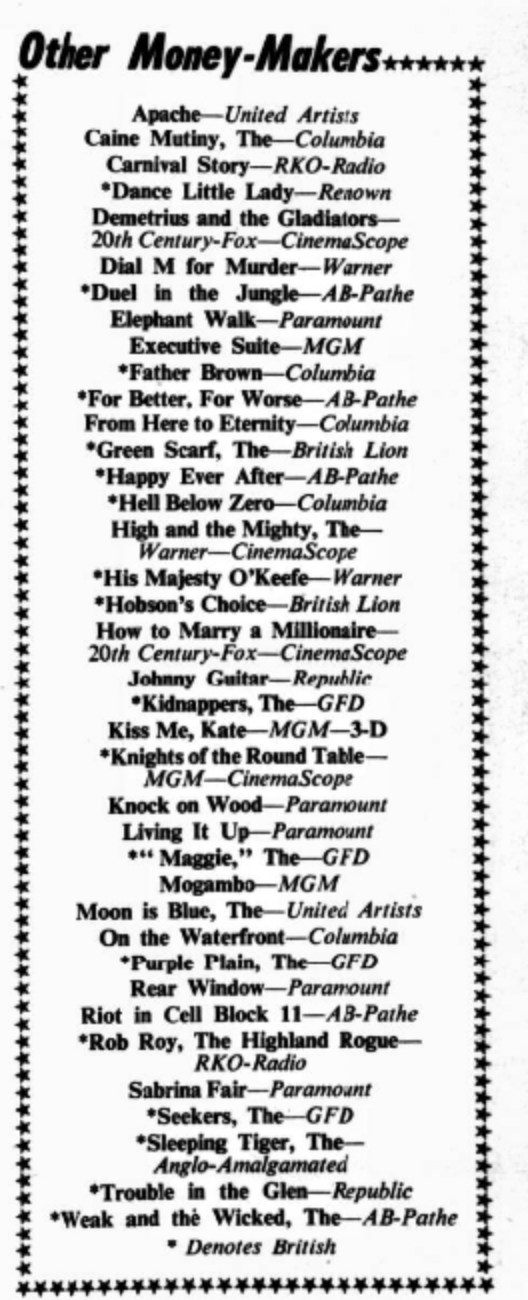
The Other Money Makers list is interesting. The British films on it were:

* Dance Little Lady (a forgotten Val Guest film with Mandy Miller and Terence Morgan - I had never heard of it)

* Duel in the Jungle (basically American adventure tale)

* Father Brown (Alec Guiness as the crime solving man of God... why no franchise?)

*For Better, for Worse (hideous newly wed Dirk Bogarde comedy)

* The Green Scarf (random mystery)

* Happy Ever After (musical with David Niven)

*Hell Below Zero (basically American adventure tale with Alan Ladd)

*His Majesty O'Keefe (lots of Aussies in that - shot on Fiji)

*Hobson's Choice (David Lean, Laughton, Mills)

*The Kidnappers

*Knights of the Round Table

*The Maggie (late Ealing comedy I had heard was a flop)

*The Purple Plain

*Rob Roy

*The Seekers ( Glynis Johns in New Zealand)

*The Sleeping Tiger

*Trouble in the Glen (so this did okay!)

* The Weak and the Wicked

It's an interesting array of movies. Lots of adventure tales shot here. Comedies very big. Some war movies. Thrillers.

Thursday, May 16, 2019

Movie review - "The Go-Between" (1971) *** (warning: spoilers)

I wonder if this film influenced all those Australian period piece of the 1970s - Picnic at Hanging Rock, Break of Day... there's a genteel quality, pretty pictures and costumes, but a sense of something happening Underneath, a little bit of sex. Break of Day especially.

I'd heard about this film for years, was curious to see it. It has a strong critical reputation. Maybe because I grew up on all those period Australian movies it didn't have the same impact.

It's well made. Alan Bates suited this sort of swaggering hair role - he was one of the hairier British male stars. Julie Christie was always solid as a demure looking woman with a sex drive - she's a star; her eyes are full of sparkle. Dominic Guard is a bit stiff. Edward Fox is touching.

Entirely good movie with some great moments (busting them having sex, Bates' death) and I enjoyed the cricket game. Just wasn't blown away.

Wednesday, August 15, 2018

Random thoughts on Bryan Forbes vs Nat Cohen at EMI Films

Current obsession - Bryan Forbes' stint of production as head of EMI Films. First read about it in Alexander Walker's book Hollywood England then it's sequel National Heroes and in Forbes' own book.

In brief, EMI took over ABPC - who were a cinema chain that dabbled in production. Forbes was brought in to run the film unit. His reputation was high as a writer-director - he'd made some impressive films such as Whistle Down the Wind. He was going to bring Class to British films.

But EMI hedged their bets - they also had a film unit under Nat Cohen. Cohen was an enormously experienced executive who ran an organisation called Anglo-Amalgamated - they did a bunch of films with AIP as well as helping finance early John Schlesinger films.

The two man had duelling units. I'll compare their output from 1970-71 - I hope I've got my facts correct. Cohen outlasted Forbes as an executive for a considerable time.

Bryan Forbes Films

* Eyewitness (Jun 1970) - a remake of The Window. Forbes said he wanted to give young directors a go and here he backed John Hough so good on him. Haven't seen this film - it doesn't seem widely known. Had a semi-name in Mark Lester. It feels like it was an unpretentious programmer that maybe thrived better in the 1950s and 1960s but no disgrace.

* And Soon the Darkness (Jul 1970)  - thriller about girls in the French countryside. From Robert Fuest. Unpretentious programmer - a good choice I think.

* Hoffman (Jul 1970) - I can see why Forbes greenlit it. Peter Sellers in a drama. It could've been good. It wasn't. Sellers would bag the production. I don't blame Forbes for making the film though... a risk worth taking. Probably needed a really good director and I'm not sure Alvin Rakoff was the front rank.

* The Man Who Haunted Himself (Jul 1970) - thriller, Roger Moore's favourite performance. A flop. Good to have made though - a real cult film now.

* The Breaking of Bumbo (Sep 1970) - I can see the rationale: an attempt at a Virgin Soldiers style romp. Directed by the author of the novel. No stars. Very risky. But an arguable risk.

* The Railway Children (Dec 1970) - a risk that paid off big time. It helped that the source novel was very well known. Forbes' punt on Lionel Jeffries reaped strong dividends. Forbes' first hit.

* A Fine and Private Place (1970) - a disaster. The director struggled and was replaced. A risk that did not take off.

* The Raging Moon (Jan 1971) - Forbes was a talented writer-director but running a studio is a full time job and I think it was silly of him to over-stretch himself by making this film. It also had a risky subject matter too - paraplegics in love.

* The Tales of Beatrix Potter (Jun 1971) - a risk that paid off, but like Railway Children it had a better known source material.

* Mr. Forbush and the Penguins (Dec 1971) - this was a commercial sounding film, but it had a tricky production, a star who has been respected more than popular (John Hurt) and was not a success. I think it's the sort of film the British industry are good at and I can't blame Forbes for trying.

* Dulcima (Dec 1971) - a middle aged man has sex with a manic pixie dream girl. Urgh. No one saw it.

Forbes also said it was he who greenlit The Go-Between (1971) from Joseph Losey - Cohen has taken credit for it. Robert Littman was in charge of MGM England. This an accomplished film with stars which did extremely well critically though not really commercially. But a film to be proud of.

So what about Forbes' legacy? Every film was defendable. All but one were based on novels. He gave new talent a go. That talent didn't always rise to the occasion - maybe he wasn't the best spotter of talent. That can't be helped.

I think it was overly ambitious program - he tried to do too much too soon. Most of the projects had to really really work to come off. Everything had to click.  There were three thrillers - but even thrillers are harder to do than say horror or action. I feel he could've done with one or two action-y films and/or horror. Or something based on better known source material. 

I think all the projects he did were worth a punt, even Dulcima, they just needed to be spread out with more conservative choices.  Or at the least the films could've cost less money.

Nat Cohen's Regime

On the Buses (Jul 1971) - its weird to think how popular big screen adaptations of British TV shows were in the late 60s and 70s but they were. In particular this. A massive hit. A safe choice, cheap - paid off big time.

Blood from the Mummy's Tomb (Oct 1971) - one of several Hammer co productions. A mummy film with a famously troubled production. Worth doing you just wish it was better.

Get Carter (1971) - an MGM/EMI co pro. I'm not sure if it was Cohen who greenlit this to be fair, I think it was more Robert Littman, but it was a solid success at the time, and is beloved.

The Boy Friend (1971) - another MGM/EMI co pro. Ken Russell did it. The film has a varying reputation but worth a go.

All the Way Up (1970) - a vehicle for Warren Mitchell, based on a play. The sort of film that might've worked in the early 1960s.

Spring and Port Wine (Feb 1970) - another adaptation of a play. Didn't do that well. 

Entertaining Mr Sloane (Apr 1970) - a play adaptation done by new talent. This could've been a Forbes regime show. Cohen's regime was famous for it's crassly commercial films but he greenlit stuff like this too.

Percy (Feb 1971) - high concept sex comedy from the team of Thomas-Box and a big hit.

Up Pompeii (Mar 1971) - adaptation of a TV show and very popular

Villain (May 1971) - gangster flick which benefited from a star turn from Richard Burton. This is the sort of movie Forbes could and should have made more of... but he didn't like violence.

Family Life (Dec 1971) (AE) - arthouse stuff from Ken Loach.

So what about Cohen's slate? Far more varied than people gave him credit for... there's a sex comedy and a several adaptations of TV shows (Cohen would, not surprisingly, make a bunch more of these), but also a gangster film, a horror film, some play adaptations, a Ken Loach.

Forbes had great intentions and did some very good things - it's a shame he didn't stick around. Maybe had he been given a smaller slate eg five films a year or something. Or maybe he wasn't cut out for it in the long run. Cohen was very skilled and should be better known.
-->

Tuesday, September 26, 2017

Dirk Bogarde Top Ten

1) Doctor at Sea  (1955) - high-spirited fun comedy, which I prefer to the first one because it has some sea views and Brigitte Bardot
2) Victim (1961) - for an actor in the closet Bogarde played an amazing number of gay characters for the time - this one notably, a hard hitting genuinely entertaining thriller that became unfashionable for a time but retains its power
3) The Servant (1963) - Bogarde played a few creepy corrupters in his career but this was perhaps his greatest performance in that genre
4) A Tale of Two Cities (1958) - perhaps Ralph Thomas' best film, a very fine adaptation of the novel with Bogarde excellently cast.
5) Hunted (1952) - part of the young-kid-idolising-a-crook genre, with Bogarde excellent as a spiv
6) The Blue Lamp (1949) - Bogarde makes a superb villain and I wish he'd played more
7) The Wind Cannot Read (1958) - presumably David Lean would've made a better film but this is a pretty good melodrama
8) The Doctor's Dilemma (1959) - Bogarde and Shaw go together well in a literate, entertaining film
9) Death in Venice (1971) - it is about, well, a pedophile and has some shocking make up but is very well done
10) Cast a Giant Shadow (1955) - Bogarde again makes a marvellous villain well teamed with Margaret Lockwood in character actor mode

Sunday, June 05, 2016

Book review - Richard Burton Diaries (published 2012)

Every Richard Burton fan should read this - a fascinating insight into the man, his thoughts, ramblings, demons, passions. Melyvn Bragg's biography quotes extensively from these but nothing beats reading them, and there's a fair bit to go around- it's not consistent, with great gaps at key periods, but there is a lot, particularly in the late 60s and early 70s.

It's all there - constant talk to "E"; ramblings about politics, sport, human nature, the industry; accounts of the making of various films; traveling to various glamorous locales. I was aware Burton was a great reader though not how passionately and consistently - as he himself writes at one stage, literature, not acting or theatre or films, was the great love of his life. He read all sorts of books too: the classics, biographies, histories, pulp, classy pulp.

I didn't realise how much of a family man he was - even though the kids didn't live with them most of the time they are always turning up for breaks and the diary entries are full of concerns for what they've been up to.

The most comprehensive behind the scenes accounts concern Raid on Rommell, Staircase, Boom, Villain, Taming of the Shrew, Anne of a Thousand Days, Assassination of Trotsky, Bluebeard plus the early 80s revival of Camelot.

The most entertaining bits are (sorry have to admit it) the bitch sessions - slagging off on actors (Elliot Gould), directors (Franco Zefferelli).  He goes back and forth on Joe Losey. There are some fascinating "I remember when" bits, especially recalling getting contracted to Alex Korda, making My Cousin Rachel, the making of Cleopatra. There's also things like watching Alexander the Great on TV, making fun of Ice Palace.

There is a lot of genuine affection and admiration for Taylor (with whom he had a healthy sex life) and his family, mixed in with concern. His marriage to Susan Hunt clearly had good times too. He is enthusiastic about Welsh rugby and has interesting things to say about other actors.

The most moving entries concern his drinking - self loathing, little congratulatory moments when he cuts down on his drinking. It's a very big book but is very gripping.

Saturday, December 20, 2014

Book review - "Hollywood England" by Alexander Walker

Invaluable account of the British film boom of the 1960s and subsequent bust, with a skilful appreciation of the talents involved and the artistic and corporate industry within which they worked. Occasionally it falls into the trap of whininess - all of Walker's British film industry books have this flaw, "why did they do it that way?" 

He also waffles at times and overlooks some key films from the era - there's nary a mention of horror or comedy, two massively popular genres from the period.

But there is some terrific stuff, such as the story behind the Bonds, early works of Schlesinger, Boorman, Richardson etc, the role of Nat Cohen, the finale involving Bryan Forbes, the regimes of United Artist and Universal, etc.

Friday, July 06, 2012

Movie review - "The Servant" (1963) ****

Sometimes it just all comes together - Dirk Bogarde expressed the desire to give a great performance in a great film, and Joe Losey came through for him, with the considerable help of Harold Pinter. It all works - the claustrophobic setting, black and white photography, music score, Sarah Miles electric performance as Bogarde's mysterious and extremely sexy (and leggy) "sister", James Fox as the weak aristocrat, Wendy Craig as the sensible girlfriend (probably the most thankless role as she is a bit of killjoy but important because she's the antagonist).

Maybe I didn't quite buy that someone like Fox would have a manservant in the first place but that's probably just me and my cultural biases. And it did feel as though it went on a bit long - maybe 20 minutes could have been cut (or maybe it's just I got weary with descent-descent-descent - Fox's weakness is hardly a challenge).

Losey's stylish direction is spot on: reflections through mirrors, careful framing, the whole "smell" of decadence. Bogarde had played rotten charmers a few times by now but never better here, with his crooked smile, superior air, lower class accent, homoerotic air around Fox, kinky relationship with Miles. One of the best things Pinter ever did.

Wednesday, May 30, 2012

Movie review - "The Criminal" (1960) **1/2 (warning: spoilers)

A fusion of the American and British gangster film - expat director Joe Losey has a high old time with this tale of hardened crim Stanley Baker who gets out of prison, where he is top dog, and sets about promptly going back to his old ways, organising a stick up of a race trek (shades of The Killing!), and winds up back there.

Baker is in his element here as a hard man, who thinks he's on top of it all, but winds up being outwitted by women, prison guards and his fellow crims. There's an interesting jazz soundtrack (Cleo Laine sings the title song), Aussies will love seeing a huge bald Aussie prisoner in gaol, an unflinching look at prison life, some effective riot sequences, funky cinematography.

Like a lot of Losey movies the female characters aren't that great - Baker is tormented by his over acting, drunken ex and sleeps with a gangster groupie. Also the plot feels repetitive - get out of gaol, rob something, wind up back in gaol, escape from gaol. But it's good, tough entertainment with fine work from Baker and the male support cast (including Patrick Magee as a sadistic warden).

Thursday, April 05, 2012

Movie review - "The Sleeping Tiger" (1954) ** (warning: spoilers)

The first collaboration of Dirk Bogarde and Joseph Losey has interesting parallels to their later classic The Servant - again he's a mysterious, dangerous man who is invited into a household by a man of a higher social class and wrecks havoc with the man's wife. In this case the household is psychiatrist Alexander Knox and wife Alexis Smith, whose marriage is soon seen to have plenty of flaws. Bogarde and Smith have an affair and Smith goes batty.

This starts very well, with Bogarde in superb touch as a seductive crook and Smith also excellent as the housewife whose passion Bogarde unleashes by smacking around the maid and taking her to wild jazz-playing Soho nightclubs. But then it sort of runs out of ideas - there are too many investigative scenes with cops asking questions that feel repetitive.

Knox is a bit bland (he doesn't even seem to care when he catches his wife and Bogarde in a dodgy embrace); although is smugness is good, he really needs something more for us to get into this character - what sort of man allows himself to be cuckolded, then makes up fake alibis, etc. Bogarde's "I'm like this because they took my fire engine away when I was little" scene is not very convincing.

And it was annoying how at the end Knox and Bogarde gang up on Smith e.g. Bogarde dumping her, Knox pretending to shoot Bogarde (what a mind f*ck), and it's Smith who dies not Bogarde - there was an anti-female slant to Losey's work with would constantly re-emerge. It gets a bit silly and dull.

Sunday, April 01, 2012

Movie review - "Accident" (1967) **1/2

Harold Pinter and Joseph Losey were made for each other - Losey's stylish visuals perfectly combed with Pinter's nuances and pauses, creating memorably creepy entertainment. This isn't as well known as The Servant - and I'm not surprised because after an intriguing start it becomes dull.

The film starts with an accident in which young Michael York is killed and beautiful Jacqueline Sassard lives. Dirk Bogarde rescues her and we flash back to their relationship. Basically Bogarde is York's tutor and he lusts after his girlfriend - who is also chased by Stanley Baker.

There are plenty of creepy bits like the chair at the tennis match which is suddenly empty, and Bogarde stalking in to a room at night. But after a while I did get a bit sick of it. The Servant had a steadily rising narrative line as James Fox sunk further into depravity. This is just bits and pieces - you long for someone to want to kill someone else.

Bogarde is excellent as the mid life crisis Don - all the outward signs of success (nice house, good job, wife and kids) but still pining for a hot bit of French totty, jealous of his student's youth and looks and his friend Baker's fame. Baker is effective as an academic - not an all time great performance (it smacked a little of gimmick e.g. "hey it's Stanley Baker playing an academic how non typecasting is that?") Sassard and Vivienne Mercant have the thankless girl roles - this is really all about the guys.

Saturday, March 10, 2012

Movie review - "Modesty Blaise" (1966) ***

The cool group of swinging 60s European film decide to go commercial - Joe Losey, Dirk Bogarde (once not cool but cool with Losey), Monica Vitti, Terence Stamp. The result is an enormously erratic but enjoyable curio, which fans of the Austin Powers movies will especially enjoy. It's got some of the most memorable costumes, colour and art direction of the swinging sixties - elaborate all white rotating apartments, luscious Arab tents, groovy nightclubs, stunning Mediterranean locations, castle lairs, etc.

Monica Vitti is very beautiful but not that charismatic as Modesty. She also struggles with her English a lot and never seems where to put her performance. But after a while I got into her and she has this fascinating by-play with cockney Terence Stamp as her best mate, colleague and occasional lover - but he can't help sleeping with other women, and she sleeps with Michael Craig. They treat the adventures like a big jokey game, kind of like two kids mucking around in Europe - and occasionally their sense of fun is infectious. Modesty is very sexy and liberated here - not punished for her sexual appetite, brave, wearing a series of stunning gowns. Dirk Bogarde (billed beneath Vitti and Stamp) joins in the fun and games wearing a blonde wig and lounging around his yacht with beach boys serving him food and an oppressive mother - Bogarde may have officially been in the closet but his on screen work in the sixties (this, Victim, The Singer Not the Song) has to be among the campest of all time.

This lurches all over the place - sometimes it's dull, others it's over the top, the acting tones vary. I know it's meant to be camp but sometime's it's just plain dumb but others it's really clever and sexy - like a nude Vitti "putting something on" for Bogarde by drawing a line on her body. I didn't even mind Stamp and Vitti singing to each other - but it came out of nowhere and felt very inconsistent. So are Vitti and Stamp's performances - but Bogarde does better and Michael Craig hits the right note.

Friday, January 13, 2012

Book review – “Nicholas Ray The Glorious Failure of an American Director” by Patrick McGilligan


I admit to being a little surprised to hear that McGilligan picked Ray as a topic – but when you think about it, why not? He still has a strong cult and his life was fascinating. At one stage the French new wave critics ranked him with Welles and Hawks – now I doubt he’d be as highly regarded, although Rebel Without a Cause remains a classic. He was Mr Cult film for a long time: They Live By Night, On Dangerous Ground, Johnny Guitar, In a Lonely Place, Bigger Than Life.

Ray’s great gift seems to have been getting along with powerful people – straight out of college he went to work at a sort of architectural commune with Frank Lloyd Wright, he had associations with Thorton Wilder and Woody Guthrie (doing folk music on radio, which was news to me), Joe Losey, Elia Kazan (his most crucial relationship – he brought Ray to Hollywood) and John Houseman. Later on he prolonged his career by impressing James Dean, Howard Hughes, Lew Wasserman and Sam Bronston. Bisexual, he chalked up an impressive list of conquests – Natalie Wood (when she was a very adult 16 – this is hot reading), Shelley Winters, Marilyn Monroe, Edie Wasserman, Gavin Lambert.

Did any directors throw away their life and career as much as Ray? He got chance after chance, constantly setting up in new countries and studios but burning bridges. After wrecking his reputation in Hollywood studios he found refuge with independents, then with Sam Bronston, then other places in Europe – but kept stuffing it each time with drinking, drug taking, gambling.

The standard of the book is very high, like all McGilligan works - extremely well researched, empathetic, very strong in particular in leftist politics and the critical reputation of its subject.

Thursday, July 22, 2010

Movie review – “X the Unknown” (1956) ***

Hammer wanted to make another Quatermass movie but Nigel Kneale refused to give over the rights to his character, so they just ripped it off. Instead of Brian Donlevy we have Dean Jagger, an even less charismatic American actor playing a scientist investigating a mystery. This one involves a creature coming out of a crack in the earth.
Apparently Joe Losey was slated to direct by Dean Jagger nixed him on the grounds that he didn’t like Losey’s left-leaning politics. Imagine – Dean Jagger powerful enough to protest who directed the film! (To be fair Hammer’s US co-financiers probably had a greater say.) Leslie Norman took over instead and does a workman-like job. The support cast includes some familiar faces: Leo McKern is a journalist who seems to have an awful lot of authority (he bosses the scientists around) and Anthony Newley a soldier. A good thing too since Jagger isn’t very inspiring.
There are some excellent special effects – I love the two head-melting scenes – although when the creature grows at the end and we get a good look at it, it’s just the blob (I wonder if the makers of The Blob were inspired by this?).